
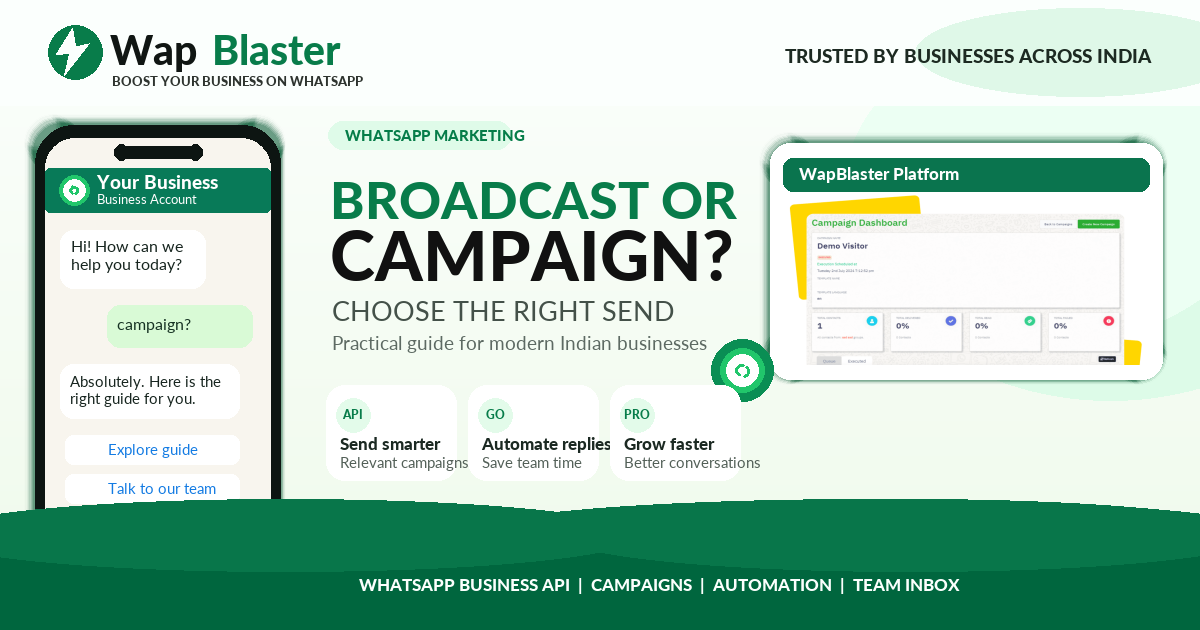
People often use broadcast and campaign to mean the same thing, but on the WhatsApp Business API they serve different purposes. Knowing when to use each helps you reach more customers while protecting your number quality. Here is the clear difference for 2026.
What is a WhatsApp broadcast
A broadcast sends the same approved template message to many contacts at once, each as a private one-to-one chat. It is best for announcements, offers and updates going to a large, opted-in audience.
What is a WhatsApp campaign
A campaign is a managed send with scheduling, audience segmentation, personalisation and reporting on top of the broadcast. It is broadcasting done properly, with control over timing, targeting and tracking.
When to use each
- Broadcast: a quick, one-off message to a known list.
- Campaign: targeted, scheduled or recurring sends where you want segmentation and analytics.
Protecting your quality rating
- Only message contacts who opted in.
- Personalise and keep content genuinely useful.
- Segment so each message is relevant.
- Watch delivery, read and block rates and adjust.
How WapBlaster helps
WapBlaster gives you scheduled campaigns, segmentation and full delivery reporting on top of the official API. Plan smarter sends on the WapBlaster platform.
A decision framework for choosing
If you are unsure whether a given send should be a simple broadcast or a managed campaign, use a quick test. Ask: does this need targeting, timing or measurement? A one-off announcement to your whole opted-in list, with no segmentation and no need to track beyond delivery, is fine as a straightforward broadcast. Anything where you want to reach a specific segment, send at a scheduled or recurring time, personalise at scale, or measure conversions and revenue, belongs in a campaign. In practice, as your programme matures, most sends graduate from broadcasts to campaigns because the extra control pays for itself.
How segmentation changes results
The biggest reason campaigns outperform raw broadcasts is segmentation. Sending everyone the same message wastes conversations on people it does not fit and trains your audience to ignore you. Segmenting by purchase history, engagement, location or interest lets each message land as relevant, which lifts read and reply rates and lowers opt-outs and blocks. The same content sent to the right 2,000 people will usually beat sending it to the wrong 10,000, both in results and in cost per outcome, because you are not paying for conversations that were never going to convert.
Protecting deliverability whichever you use
Whether you broadcast or run campaigns, the rules that protect your number are the same: message only opted-in contacts, use approved templates for business-initiated messages, keep content relevant and valuable, and honour opt-outs instantly. Watch your quality rating and block rate after every send. Campaigns give you better tools to do this well, segmentation, scheduling and reporting, but the discipline matters regardless of the label. Get it right and you can send confidently at scale; get it wrong and even a modest broadcast can dent your deliverability.
Frequently asked questions
What is the difference between a WhatsApp broadcast and a campaign?
A broadcast sends one approved template to many contacts at once. A campaign adds scheduling, segmentation, personalisation and reporting on top of that broadcast.
Will broadcasting get my number blocked?
Not if you only message opted-in contacts, use approved templates and keep content relevant. Blocks and reports are what hurt your quality rating.
Which should a small business use?
Start with simple broadcasts for one-off announcements, and move to campaigns when you need segmentation, scheduling and analytics.