
Everyone agrees chatbots save time, but "saves time" does not get budget approved. To justify automation you need numbers: how many conversations it handles, what each one would have cost a human, and what that adds up to. Here is how to measure WhatsApp chatbot ROI properly.
Start with deflection rate
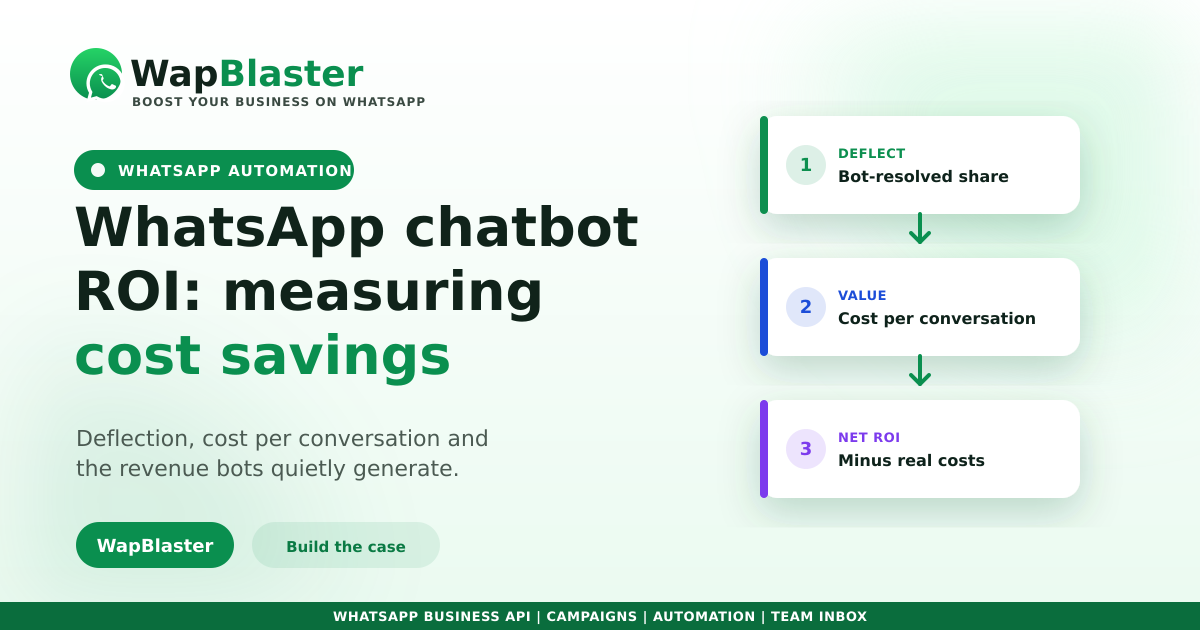
The core metric is how many conversations the bot resolves without a human touching them.
- Count conversations fully handled by the bot.
- Count those escalated to an agent.
- Deflection rate is resolved divided by total.
Put a cost on a human conversation
Work out your blended cost per handled conversation, agent salary and tooling divided by conversations handled. Multiply that by deflected conversations and you have gross saving. Our conversation analytics guide covers the inputs.
Count the revenue side too
Cost saving is only half the story. Bots also earn money by responding instantly when humans are not available.
- Leads captured outside business hours.
- Faster first response lifting conversion.
- Recovered carts and completed bookings.
Subtract the honest costs
A credible business case includes what the bot costs: platform fees, conversation charges, and the time spent building and maintaining flows. ROI is net benefit over total cost, not gross saving.
Track it over time
Bot ROI improves as flows mature and you automate more of the common cases, following our workflow guide. Review metrics monthly and expand what works, rather than judging it in week one.
Frequently asked questions
How do I calculate WhatsApp chatbot ROI?
Measure deflection rate, the share of conversations resolved without a human, multiply by your cost per human-handled conversation to get gross saving, add revenue the bot generates, then subtract platform, conversation and build costs to reach net ROI.
What is a good chatbot deflection rate?
It varies by business and how repetitive your queries are. Rather than target a universal figure, establish your own baseline and improve it by automating the most common questions first, then expanding as flows mature.
Does a chatbot only save money on support?
No. It also generates revenue by replying instantly when your team is unavailable, capturing after-hours leads, improving first-response time and recovering abandoned carts or incomplete bookings. Both sides belong in the business case.
How soon will a WhatsApp chatbot pay back?
It depends on volume and how much of it is repetitive. High-volume, repetitive query sets pay back fastest. Returns improve over time as you automate more common cases, so judge it over months rather than the first week.
Build a bot that pays for itself. Explore WapBlaster automation or start free.