
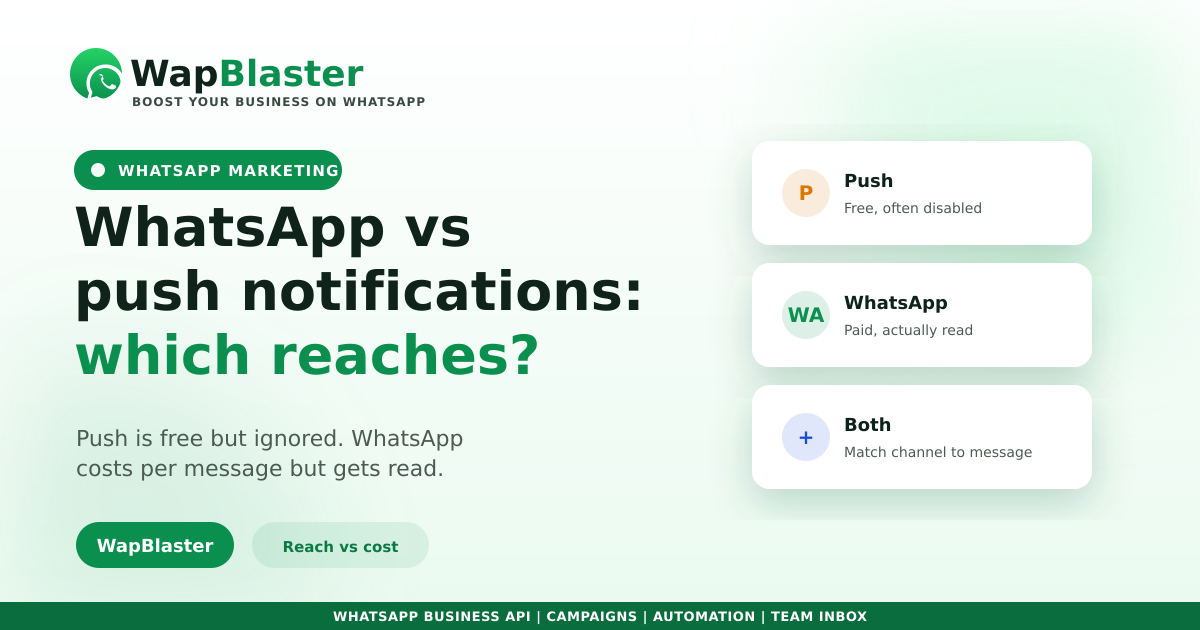
If you have an app, you already have push notifications, and they cost nothing to send. So why would you pay to message the same users on WhatsApp? Because reach and attention are not the same thing. Here is an honest comparison of the two channels and when each one wins.
Reach: who actually receives it
Push only reaches users who installed your app and left notifications enabled, which is often a minority.
- Push requires the app installed and permission granted.
- Many users deny or later disable push permissions.
- WhatsApp reaches anyone who opted in, no app install needed.
Attention: who reads it
Push notifications stack up on a lock screen and get swiped away. WhatsApp messages sit in a conversation list people actively check, which is why engagement is so much higher.
Cost: the real trade-off
Push is effectively free; WhatsApp charges per conversation, as covered in our pricing guide. So the question is not which is cheaper per send, but which delivers more value per rupee spent. For high-value or time-critical messages, WhatsApp usually wins on return.
Two-way versus one-way
Push is a dead end: the user taps or ignores. WhatsApp is a conversation, so the customer can reply, ask a question and buy without leaving the thread. That alone changes what the channel can do.
Use both, deliberately
The smart approach is to match channel to message.
- Push for in-app nudges and low-stakes, high-frequency updates.
- WhatsApp for important, time-sensitive or revenue-driving messages.
- WhatsApp as the fallback when push is disabled or undelivered.
Frequently asked questions
Is WhatsApp better than push notifications?
For important, time-sensitive or revenue-driving messages, usually yes, because WhatsApp reaches more people and actually gets read. Push is better for low-stakes, high-frequency in-app nudges since it costs nothing. Most businesses use both.
Why do push notifications have low reach?
Push only reaches users who installed your app and kept notifications enabled, which is often a minority. Many deny permission upfront or disable it later. WhatsApp needs no app install, just an opt-in, so it reaches far more people.
Is WhatsApp worth paying for when push is free?
It depends on message value. Push costs nothing but is widely ignored, so a free send with no outcome is not a saving. For messages that drive revenue or need to be seen quickly, WhatsApp's higher read rate usually justifies the cost.
Can I use WhatsApp as a fallback for push?
Yes, and it is a practical pattern. When push is disabled or goes undelivered, routing the important messages to WhatsApp recovers reach you would otherwise lose, while keeping routine nudges on the free channel.
Reach users who actually read. Explore WapBlaster or start free.